

How To Read Construction Drawings Youtube
We use cookies to ensure nosotros give you the best experience on our website. Y'all can observe out about our cookies and how to disable cookies in our Privacy Policy. If yous continue to use this website without disabling cookies, we volition assume you are happy to receive them. Shut.

How to read technical drawings
Contents
- 1 Introduction
- 2 Border
- 3 Title block
- iv Revision block
- 5 Calibration
- vi Basic symbols
- 7 Note and units
- 8 Circled numbers
- 9 Projections and views
- x Abbreviations
- 11 Find out more
- 11.1 Related articles on Designing Buildings Wiki
- xi.ii External references
[edit] Introduction
The term 'technical cartoon' has a very broad meaning, referring to any drawing that conveys the way that something functions or how it is constructed. About drawings prepared during the afterward stages of the design and structure of buildings might be considered to be technical drawings.
It is important that the purpose for which technical drawings are being prepared and the people that will use them are carefully considered to ensure they are properly structured and adopt an advisable presentational techniques. Information technology is besides important to have an agreement of how to read them.
Some of the components common to many types of technical cartoon are prepare out below.
[edit] Border
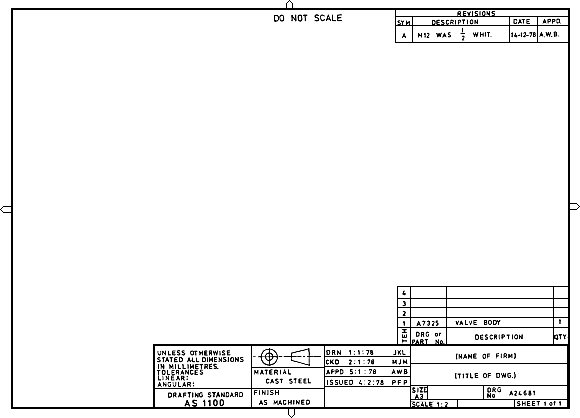
About drawings have a edge around them. This helps ensure that the full drawing is included in reproductions.
The border sometimes includes messages and numbers to delineate zones, in the same manner as a map, to aid locate and pinpoint certain areas. These letters are in alphabetical order from the bottom up on the vertical axis. The numbers are in numerical society from correct to left on the horizontal access. The zones are to be read from right to left.
[edit] Title block
A title cake will typically appear in the bottom-right corner of a drawing and contains information related to the drawing, including:
- Name: The company or agency that prepared the cartoon.
- Address: Location of the visitor or agency.
- Names and dates: Individuals who drew, checked and canonical the drawing, and the appointment they did so.
- Project: The project the drawing relates to.
- Description: What the cartoon is of.
- Status: What the drawing is for (eg for structure / for data).
- Drawing number: The assigned number to place the drawing.
- Revision: Identifies the correct version of the drawing, equally it may accept been revised several times.
- Calibration: Ratio of actual size compared to the size on the drawing / or 'do non scale' if dimensions are not to be relied upon.
- Size: The original cartoon sheet size (important for determining the scale for reproductions'. Encounter paper sizes for more than information.
[edit] Revision block
A carve up revision block may be located in the top-right corner of the cartoon, setting out:
- The number of the revision.
- The specific changes fabricated compared to the previous drawings.
- The date that the revisions were made.
- The approval of the revision.
[edit] Scale
Information technology is essential to empathise the size scale that the cartoon has been produced to. Bodily size is one:1. Where the scale is 100:ane, information technology means that the bodily size is 100 times that shown on the drawing; the commencement number represents the size of the physical chemical element, and the second number represents the drawing. It is usual that the scale volition be provided in the title block.
If the dimensions of elements on the drawing are not to be relied upon, for case if the cartoon is a sketch, or if responsibility for determining dimensions are with another party, the scale may be followed by the statement 'practise not scale' or 'not to scale'.
[edit] Basic symbols
Architectural symbols are often used to place common features such as topography, brickwork, doors, windows, fixtures and other elements. Understanding these, or having admission to a key which notates them, volition be useful in terms of interpreting the cartoon.
For more than data, see Symbols on architectural drawings.
[edit] Notation and units
The same annotation conventions should be followed past all so that there is clear communication between different people and mistakes are avoided.
Encounter Notation and units on drawings and documents for more information.
[edit] Circled numbers
The scale of drawings may exist too small to recreate all the necessary detail. In this case, circled numbers can be added to sure parts of the drawings, which bespeak that the department identified is shown in greater particular on another page.
[edit] Projections and views
Drawings generally include front, side and height of views of the object being designed. These drawings are typically drawn in either parallel or perspective projections:
- Parallel projections include orthographic drawings in which the four orthogonal views of an object are shown.
- Perspective projections are drawings in which an object is fatigued using ane-, two- or iii-betoken perspective; presenting the object as iii-dimensional.
For more than information, see Drawing projections.
Section views may also exist included which evidence a construction as though information technology has been sliced in half or cut along another imaginary airplane. For more than information, see Department drawing.
Exploded views may besides be shown, which testify how an item is assembled. Run into Assembly drawing for more information.
[edit] Abbreviations
Similar to circled numbers, abbreviations are used to indicate elements and instructions. Some common abbreviations used in drawings include:
- & - and
- AFF - in a higher place finished floor
- BSMT - basement
- BYND - beyond
- BOT - lesser
- CLG - ceiling
- CONT - continuous
- CPT - carpet
- DBL - double
- DEMO - demolition
- DIA - diameter
- DIM - dimension
- DN - down
- DP - depth
- DR - door
- DWG - drawing
- EA - each
- EJ - expansion joint
- EL - superlative
- ELEC - electrical
- ELEV - elevator/elevation
- EXT - exterior
- FIXT - fixture
- FLR - floor
- FND - foundation
- GA - gauge
- Hello - loftier
- HP - loftier point
- HVAC - heating, ventilating and air conditioning
- INSUL - insulation
- INT - interior
- LO - low
- MECH - mechanical
- MEMBR - membrane
- MTL - metal
- NO - number
- NOM - nominal
- OC - on eye
- PLUMB - plumbing
- PLYD - plywood
- PNT - paint/painted
- PVC - polyvinyl chloride
- REQD - required
- RM - room
- SIM - similar
- SPEC - specified
- STRUCT - structure
- TO - top of
- UNO - unless noted otherwise
- U/Due south - underside
- VIF - verify in field
- W/ - with
For more information see Acronyms.
[edit] Find out more
[edit] Related articles on Designing Buildings Wiki
- Every bit-built drawings and record drawings.
- Assembly drawing.
- Component drawing.
- Reckoner aided pattern.
- Concept drawing.
- Item drawing.
- Elevations.
- Engineering cartoon.
- General arrangement drawing.
- How to accept off construction works.
- Installation drawings.
- Notation and units on drawings and documents.
- Paper sizes.
- Production information.
- Projections.
- Section drawing.
- Symbols on architectural drawings.
- Types of drawing.
- Working drawing.
[edit] External references
- VistaIndustrial - How to read a drawing

Source: https://www.designingbuildings.co.uk/wiki/How_to_read_technical_drawings
Posted by: cainrothe1964.blogspot.com
0 Response to "How To Read Construction Drawings Youtube"
Post a Comment